
Categories
2026, Current EventsPublished November 8, 2026
Broward Mosquito Advisory: What Homeowners Should Do Now

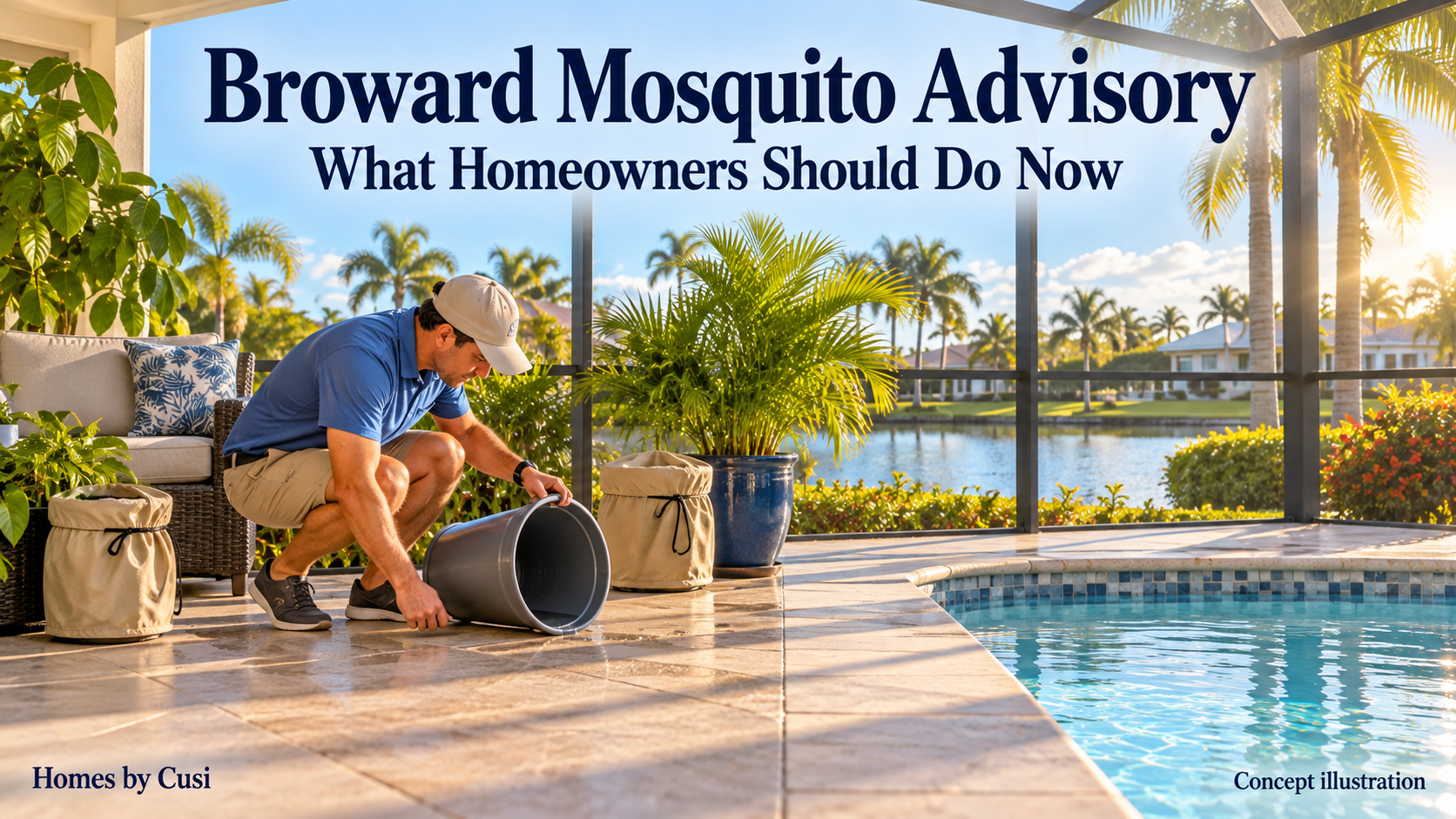
Updated November 8, 2026. Featured image is a concept illustration of a South Florida home patio, not a specific incident or property.
Broward County remains under a mosquito-borne illness advisory after the Florida Department of Health in Broward County confirmed a locally acquired dengue case in October. Health officials renewed their prevention reminder on November 4, and the state's latest weekly report still lists Broward under the advisory.
This is not a reason to panic. It is a reason to take the routine steps seriously: use repellent correctly, cover up when mosquitoes are active, dump standing water every week, and keep screens and doors in good shape.
What the advisory means
DOH-Broward issued the advisory on October 5 after confirming one human case of locally acquired dengue fever. Locally acquired means the person was infected in Broward rather than while traveling. DOH-Broward and Broward County Mosquito Control said they are coordinating surveillance, prevention and control efforts.
The Florida Department of Health's week 43 arbovirus report, covering October 25 through October 31, still listed Broward among the counties under a mosquito-borne illness advisory. Palm Beach County was also on that advisory list. The state report is the latest weekly report available as of this writing.
How dengue spreads
Dengue is usually spread through the bite of an infected Aedes mosquito. The CDC says Aedes mosquitoes can bite during the day or night and often live around people, indoors and outdoors. Dengue is not spread through ordinary casual contact.
That is why standing water matters around a home. Aedes mosquitoes lay eggs in containers that hold water. DOH-Broward says as little as one cap of water standing for more than a week is enough for mosquitoes to breed and multiply.
Symptoms and warning signs
DOH-Broward describes dengue as a flu-like illness with fever, severe muscle aches and joint pain, and sometimes a rash. It usually does not include respiratory symptoms. Symptoms can appear within 14 days after a bite from an infected mosquito.
The CDC says a blood test is the only way to confirm dengue. If you develop these symptoms after mosquito bites, contact a healthcare provider rather than trying to self-diagnose.
Severe dengue is a medical emergency. The CDC says warning signs usually begin 24 to 48 hours after the fever goes away. Get emergency care for belly pain or tenderness, vomiting at least three times in 24 hours, bleeding from the nose or gums, vomiting blood, blood in the stool, or feeling extremely tired, restless or irritable.
What homeowners should do this week
Start outside. Once a week, empty or cover anything that can hold water: buckets, toys, child pools and pool covers, birdbaths, trash lids, recycling bins, boat or car covers, roof gutters, coolers, pet dishes and tires. Check plant saucers and the corners of a lanai where water can sit after irrigation or rain.
Use repellent the right way. DOH-Broward recommends reading the label before applying. Apply repellent to exposed skin or clothing, not under clothing, and make sure the product is age-appropriate for children. EPA-registered repellents are proven safe and effective when used as directed, including for pregnant and breastfeeding women. Clothing and gear can be treated with products containing 0.5% permethrin, but permethrin should never go directly on skin.
Wear loose-fitting, long-sleeved shirts and pants when mosquitoes are active. Keep mosquitoes outside by using air conditioning, repairing holes in screens, and keeping doors and exterior windows closed.
The real estate angle
For buyers, this is part of normal South Florida home ownership. When you walk a property, look at the same maintenance items you would check anyway: gutters, screens, pool covers, irrigation overspray, shaded side yards and places where water sits after a storm.
For sellers, a quick weekly water sweep is a simple showing prep step. It helps the yard show better, and it matches the current health department guidance.
The advisory does not tell us to avoid a neighborhood, and it is not a home-value story. It is a practical homeowner reminder from health officials.
Questions about living in Broward or Palm Beach County? Call or text Chris Cusimano with Homes by Cusi at 561-289-9305. Call us, we're friendly.
Sources
- The Friendly Scoop's Broward mosquito advisory guide
- DOH-Broward mosquito-borne illness advisory, October 5, 2026
- DOH-Broward mosquito-borne illness awareness reminder, November 4, 2026
- Florida Department of Health arbovirus surveillance report, week 43
- CDC dengue symptoms, testing and warning signs
- CDC guidance on how dengue spreads
Checked November 8, 2026. Advisory status reflects the state's week 43 report, covering the week ending October 31. This is general information, not medical advice.

Chris Cusimano
| Homes by Cusi | Keller Williams Realty Boca Raton | PLACE | Boca Raton Realtors
or another way