
Categories
2026, Economy, Housing Market, Real Estate Taxes/HomesteadPublished June 5, 2026
Florida's $250,000 Property Tax Exemption Explained


Florida's Historic $250,000 Property Tax Exemption: What Buyers and Sellers Need to Know in 2026
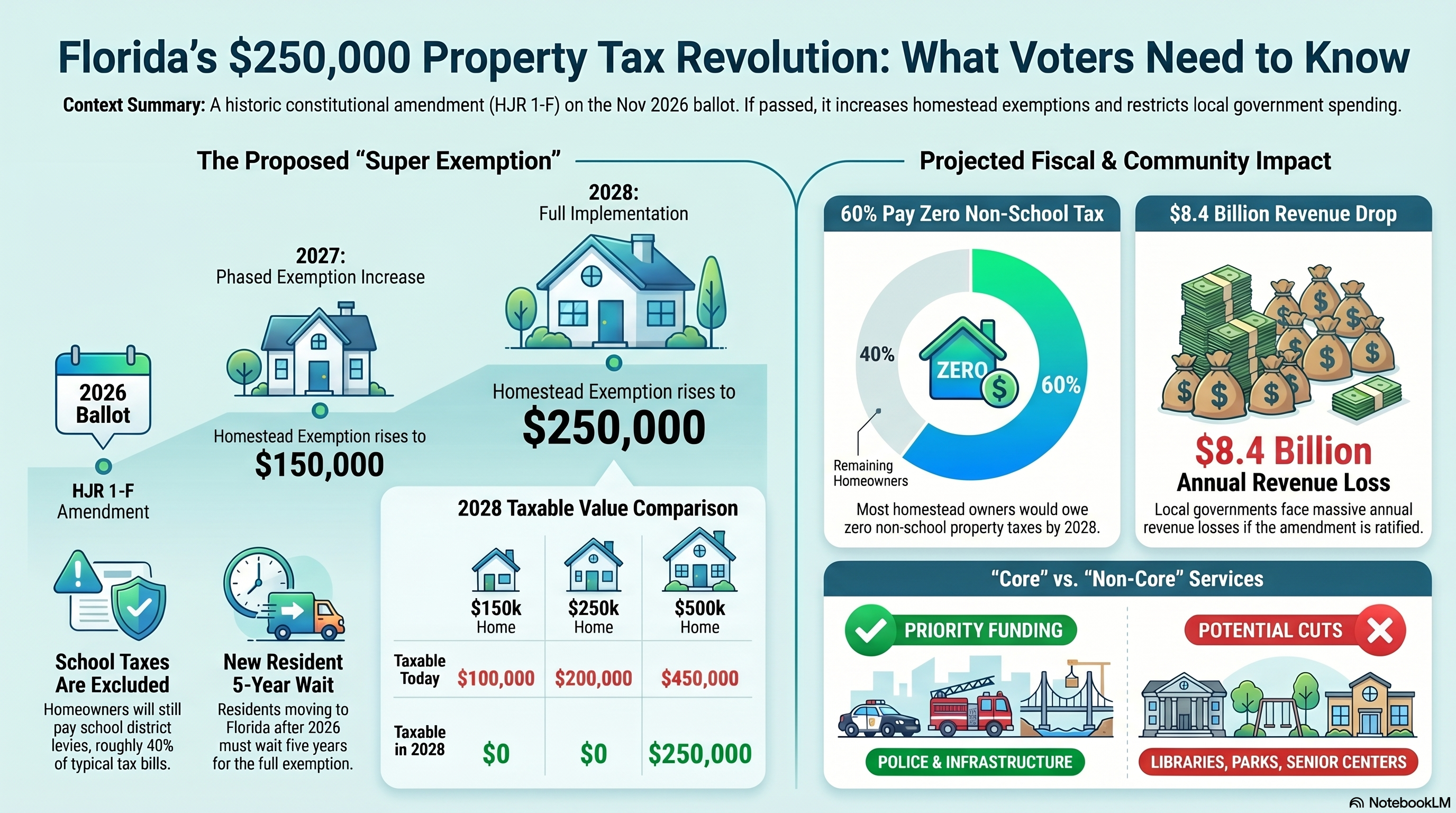
On June 2, 2026, the Florida Legislature passed a monumental property tax proposal that could fundamentally change the cost of homeownership in the Sunshine State. The "Save Our Homes from Excessive Property Taxes" amendment is officially heading to the November 3, 2026, ballot. If approved by 60% of Florida voters, it will represent the largest property tax cut in the state's history.
Whether you are looking to buy your first home, invest in a vacation property, or sell your current residence, here is exactly how this proposed legislation could impact your wallet and your real estate strategy.
How the $250,000 Exemption Works Currently, Florida's homestead exemption shields the first $50,000 of a primary residence's assessed value from property taxes. Under the new constitutional amendment, this exemption would jump to $150,000 in 2027 and reach a staggering $250,000 in 2028. Moving forward, the exemption would be adjusted annually for inflation.
However, there is an important caveat: this massive exemption applies strictly to non-school property taxes. Because local school districts rely heavily on property taxes, lawmakers modified the original bill to carve out school levies entirely, meaning homeowners will continue to pay the school portion of their tax bill under current rules.
Massive Savings for Current Homeowners For established Florida residents, the financial relief could be life-changing. The Governor's office estimates that once the $250,000 threshold is reached, roughly 60% of homesteaded Florida property owners will owe zero non-school property taxes. Depending on local tax rates, the average Florida homeowner could see their property tax bill shrink by roughly $1,500 to $1,800 every single year.
Because the exemption applies to assessed value rather than market value, long-time homeowners whose property assessments have been kept artificially low by the existing 3% Save Our Homes cap will easily fall under the $250,000 threshold.
Moving to Florida? Note the 5-Year Waiting Period If you are relocating to Florida and looking to buy, the rules are slightly different. To prevent a sudden, massive migration surge driven solely by this tax break, the legislature included a residency requirement. Anyone establishing Florida residency after December 31, 2026, will not immediately qualify for the $250,000 super exemption. Instead, new residents will receive the standard $50,000 exemption for their first five years before unlocking the full benefit, though local cities and counties have the option to shorten this waiting period.
A Win for Investors and Second Homes While the headline-grabbing $250,000 exemption is reserved for primary residences, non-homestead properties are also getting a substantial tax shield. Beginning January 1, 2027, the annual cap on assessed value increases for rental properties, vacation homes, and commercial real estate will drop from 10% to 5%. This will provide much-needed long-term predictability for real estate investors.
Real Estate Strategy: What Should You Do Now?
- Do not delay your home search: If you are buying a home in 2026, base your affordability calculations on current tax laws. The new exemption will not affect tax bills until 2027 at the earliest, and it still requires voter approval.
- Protect your portability: If you are selling your home to upsize or downsize, do not forget about your existing Save Our Homes portability. Florida allows you to transfer up to $500,000 of your accumulated tax benefit to your next primary residence, which remains essential for keeping your school property taxes as low as possible.
- Vote in November: The amendment requires a 60% supermajority to pass, meaning every vote on November 3, 2026, will be critical.
Ready to navigate the Florida real estate market? Contact us today to learn how these upcoming tax changes could impact your buying power or the resale value of your home!
- Chris Cusimano
Sources with Direct Links:
- Florida's $250,000 Homestead Exemption: What It Means for Your Tax Bill (2026)
- Publisher: Property Exemption
- Florida Property Tax Elimination: DeSantis Plan 2026
- Publisher: Property Exemption
- Senate Passes Historic $250,000 Property Tax Cut for Florida Homeowners
- Publisher: The Florida Senate
- Constitutional Amendment 5 Annual Inflation Adjustment to Homestead Exemption Value
- Publisher: Florida Department of Revenue
Additional Sources Used (Links not explicitly provided in the text):
- Florida Legislature approves DeSantis property tax cut plan for November ballot
- Publisher: FOX 13 Tampa Bay
- Florida property tax cut plan backed by DeSantis heads to November ballot after legislative approval
- Publisher: CBS Miami
- Florida Property Tax Relief in 2026: The Save Our Homes Plan
- Publisher: DJ & Lindsey Real Estate
- Property tax amendment heads to voters
- Publisher: Florida Realtors
- Florida Legislature Sends Property Tax Proposal to the November Ballot
- Publisher: Housing Action Lab at the Florida Housing Coalition
- Map: Projected Revenue Loss for Florida School Districts and Counties Under Governor's Property Tax Reform Proposal
- Publisher: Florida Policy Institute

Chris Cusimano
| Homes by Cusi | Keller Williams Realty Boca Raton | PLACE | Boca Raton Realtors
or another way