
Categories
2026, Insurance, Current EventsPublished July 15, 2026
Hurricane Season 2026: What It Means for Your Insurance, Your Deductible, and Your Home's Value

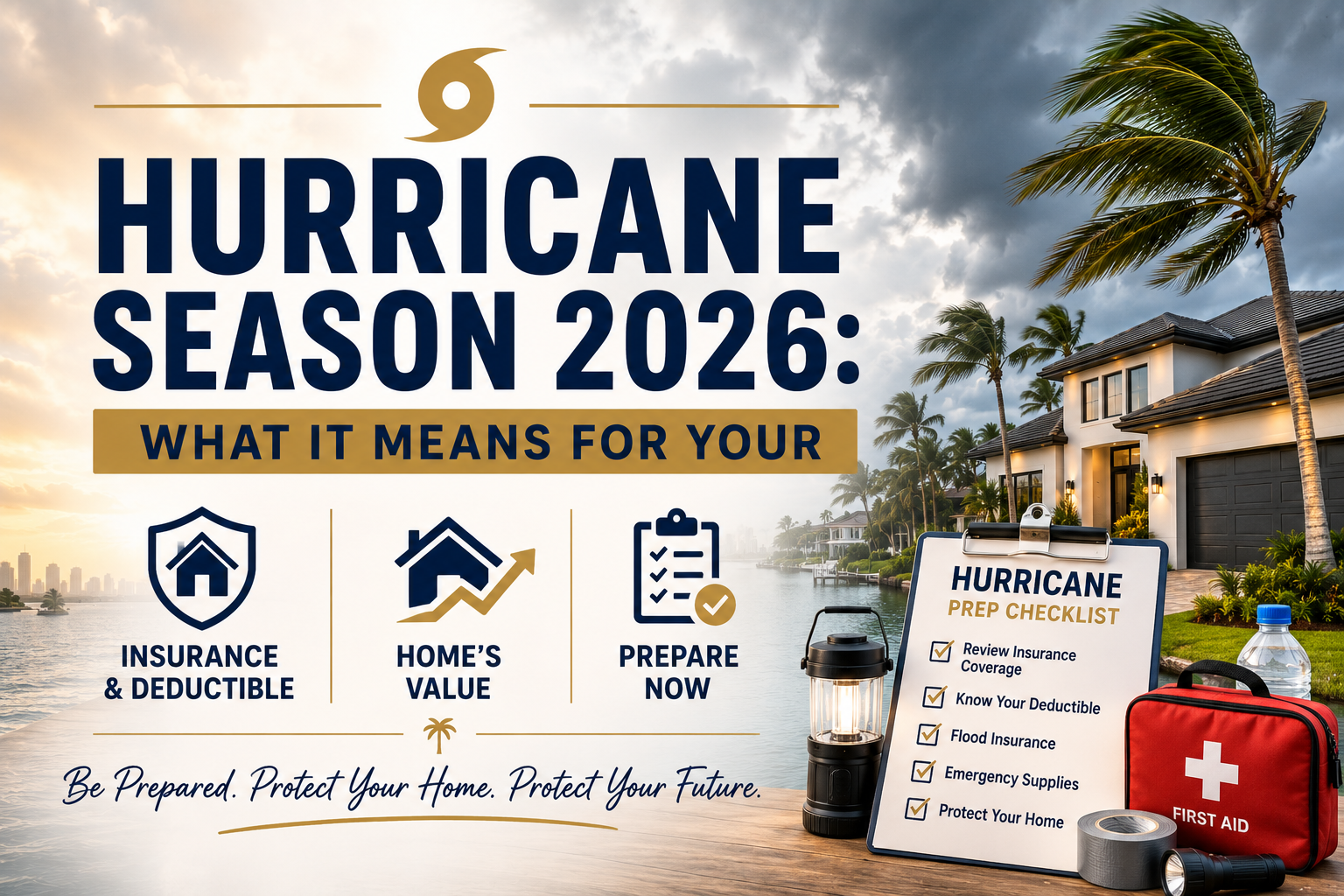
Hurricane Season 2026: What It Means for Your Insurance, Your Deductible, and Your Home's Value
The forecast says quiet. Prepare like it doesn't.
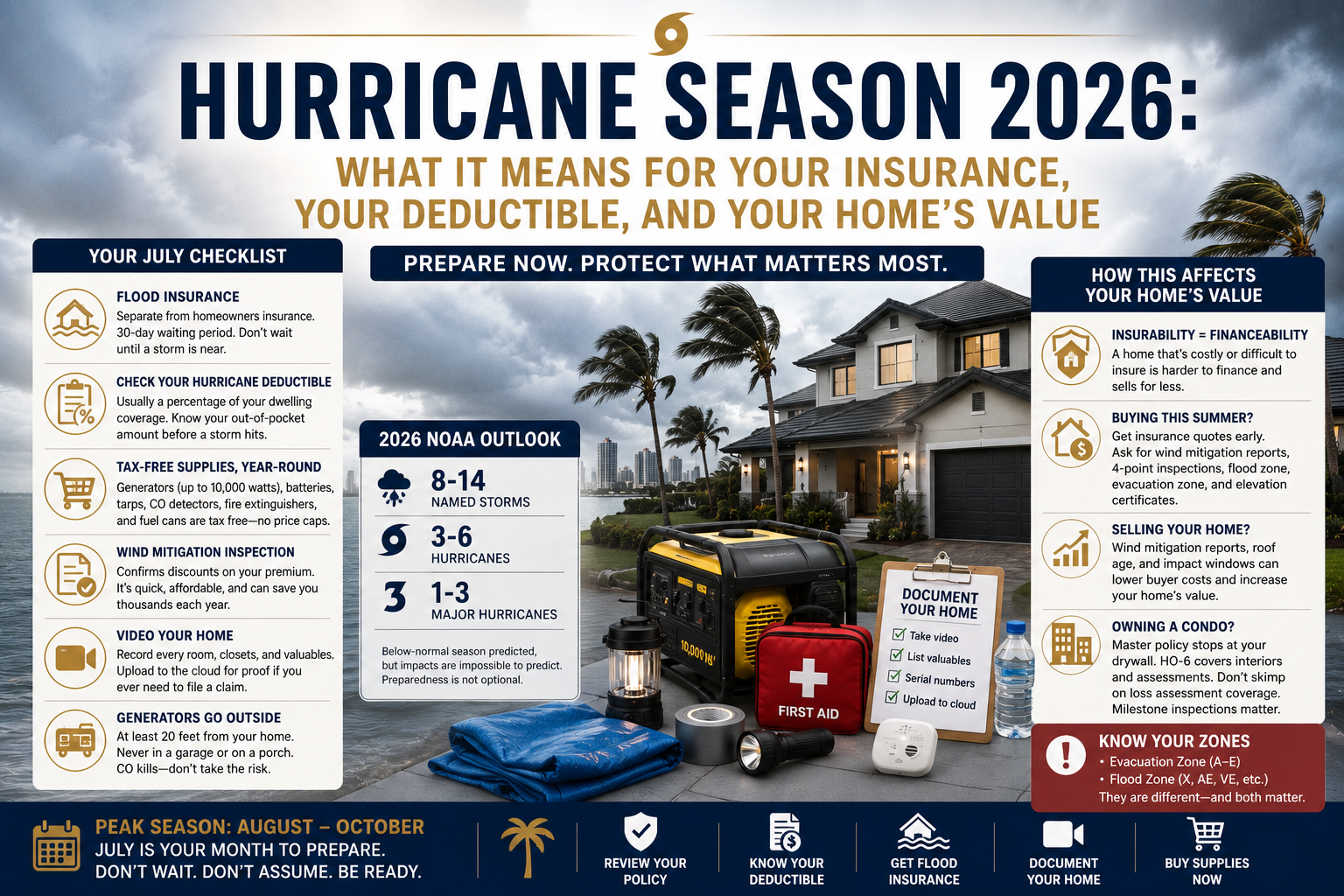
NOAA is calling for a below-normal 2026 Atlantic season. Eight to 14 named storms, three to six hurricanes, one to three of them major.
Andrew hit in 1992, during a season with seven named storms.
A seasonal outlook describes the whole basin over six months. It tells you nothing about whether a Category 3 is going to be sitting off Grand Bahama in September pointed at Boca Raton. The season peaks between August and October, which means right now, in July, is the last easy month. Stores are stocked. Contractors answer the phone. Nobody is fighting over the last sheet of plywood at 6 a.m.
After 25 years selling real estate here, I can tell you the homeowners who handle storms well are the ones who did the boring paperwork in July. And a few of those July items have gotten a lot more expensive to skip, because in 2026 South Florida, what your home costs to insure has become inseparable from what it's worth.
Three things that are entirely a July problem
Flood insurance has a 30-day waiting period. Your homeowners policy does not cover flood. Not storm surge, not rainfall, not a canal coming over its bank. It's a separate policy, and new NFIP policies generally don't take effect for 30 days. Buy it the day a storm enters the Caribbean and you're not covered for that storm. If you want protection for the peak of this season, that decision happens now.
And before you assume it doesn't apply to you: roughly one in four flood claims comes from properties outside high-risk flood zones.
Pull your declarations page and find your hurricane deductible. Florida hurricane deductibles are usually a percentage of your dwelling coverage, not a flat number. Two percent on a home insured for $600,000 is $12,000 out of pocket before your carrier pays a dollar. Most homeowners learn that figure while standing in a house with a hole in the roof. While you're in there, check whether your roof is covered at replacement cost or actual cash value, because a lot of Florida carriers have moved older roofs to depreciated schedules.
The supplies are permanently tax free now. Florida ended the temporary disaster prep sales tax holidays and replaced them with a year-round exemption, no price caps, on generators up to 10,000 watts, batteries, tarps, carbon monoxide detectors, fire extinguishers, and fuel cans. There's no window to hit anymore and no reason to wait. Buy the generator in July when there's inventory and the price hasn't surged.
The one that pays you back every year
Get a wind mitigation inspection.
That report is what you hand your carrier to confirm you're getting every discount available on the hurricane portion of your premium. For a lot of South Florida homes it's worth four figures a year, and it costs you an afternoon. The state's My Safe Florida Home program also offers free inspections and matching grants for hardening work, though funding and eligibility shift every cycle, so read the current rules at mysafeflhome.com and never start work before you have written grant approval.
Two more that take an hour combined. Video every room in your house, open the closets, narrate what things are, catch the serial numbers, and upload it to the cloud. After a loss, the burden of proving what you owned falls on you, and the people who get paid fastest are the ones with a time-stamped video from before the storm. And generators go outside, at least 20 feet from the house, never in a garage or on a porch. The most common cause of death after a Florida hurricane isn't the storm. It's carbon monoxide, and heat.
That's the short version of the prep. The long version lives on The Friendly Scoop, with evacuation zones, sandbag sites, shelter registration, and the new year-round tax exemptions.
Where this hits your home's value
Here's the part that's changed, and it's the reason I bring this up with clients in July instead of September.
Insurability now determines financeability. A home with an aging roof and no opening protection can be effectively uninsurable at a price a buyer can carry. That's not a theoretical problem, it kills deals. Which means the hurricane readiness of a house has quietly become one of the biggest drivers of what it's actually worth on the open market.
If you're buying this summer: get an insurance quote before your inspection period expires, not after. Ask for the wind mitigation report and the four-point inspection early, not deep into due diligence. Ask for the flood zone, the evacuation zone, and an elevation certificate if one exists. You want to discover an insurance problem in week one, not week four.
If you're selling: a current wind mitigation report, a documented roof age, and impact windows are among the most tangible value drivers in this market, because they show up directly in a buyer's monthly payment through the premium. If you've made those improvements, put the documentation right in the listing package. If you haven't, understand that buyers are already pricing the risk in.
If you own a condo: your association's master policy stops at your drywall. Your HO-6 covers the interior and, usually, your share of a special assessment. Loss assessment coverage is cheap and most owners don't carry enough of it. And with Florida's building safety law forcing milestone inspections and reserve studies, a building carrying deferred structural work has less margin in a storm and a harder time at the closing table.
The one-hour version
If you do nothing else this week:
- Look up your evacuation zone and your flood zone. They're different things and both matter.
- Pull your declarations page and find your hurricane deductible.
- Decide on flood insurance now, because of the 30-day wait.
- Video every room and upload it to the cloud.
- Buy the generator and the carbon monoxide detector while they're in stock and tax free.
That's an hour in July. It's the difference between managing a storm and being managed by one.
If you're thinking about buying or selling this year and want to understand how a specific property's insurance picture affects what it's worth, that's a conversation worth having before you're under contract, not after. Reach out anytime.
Our South Florida publication The Friendly Scoop has the complete prep guide, with evacuation zone lookups, sandbag distribution, shelter and pet registration, boat prep, and post-storm contractor fraud protection. [Read the full guide here.]
Chris Cusimano | Homes by Cusi | Keller Williams Realty Boca Raton

Chris Cusimano
| Homes by Cusi | Keller Williams Realty Boca Raton | PLACE | Boca Raton Realtors
or another way