
Categories
2026, Boca Raton, Coral SpringsPublished July 15, 2026
The $1.3 Billion Road Project Coming to North Broward: What It Means for Your Property Value

The $1.3 Billion Road Project Coming to North Broward: What It Means for Your Property Value
After 40 years, it's actually happening
If you've ever sat on SW 10th Street off the Sawgrass at 5 p.m., you already know the problem. Regional highway traffic and neighborhood traffic have been sharing the same three miles of road for decades, and neither one works.
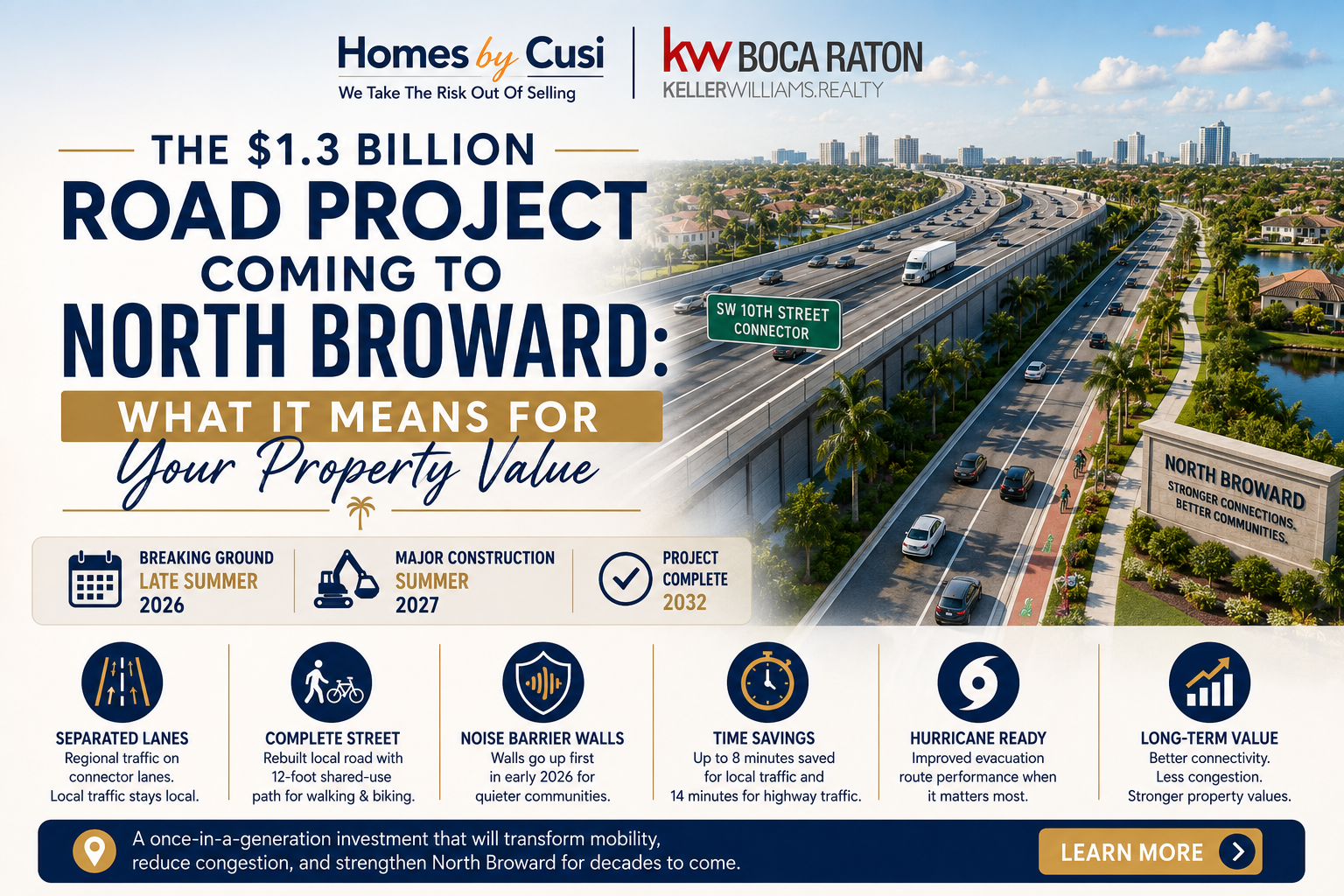
That's finally changing. FDOT is building the SW 10th Street Connector, a $1.3 billion reconstruction between the Sawgrass Expressway and I-95 in Deerfield Beach. Early construction starts late summer 2026, major construction follows in summer 2027, and the whole thing wraps in 2032.
I've had this come up in three separate client conversations in the last month, always some version of the same question: is this good or bad for my house? The honest answer is that it depends entirely on where your house sits, and that's worth understanding before you make a move either direction.
What they're actually building
The core idea is simple: stop asking one road to do two jobs.
The corridor gets split into two separate systems. Connector lanes on the north side carry regional traffic and freight between the Sawgrass and I-95, bypassing the neighborhoods entirely. Local SW 10th Street on the south side gets rebuilt as a Complete Street serving the homes and businesses along it, including a 12-foot shared-use path for walking and biking.
On I-95 itself, the express lanes double from one to two in each direction between Sample and Hillsboro, and both the SW 10th Street and Hillsboro interchanges get rebuilt.
When it's done, FDOT projects up to 8 minutes saved for local traffic and 14 minutes for highway traffic at peak. And here's the piece most people miss: SW 10th Street is a designated hurricane evacuation route. Separating regional from local traffic measurably improves how this corridor performs when a storm is coming and everyone needs to move at once. In South Florida, that's not a footnote.
If you want the full picture first, The Friendly Scoop has the construction timeline, the detours to plan around, and what changes in each of the five communities along the route. What follows here is the part that hits your equity.
The part that affects your house
Here's where I'll be straight with you, because this is the question clients actually care about.
In the near term, construction is a drag. Six years of noise, dust, and detours next to your house is not a selling point, and buyers price it in. If you're thinking about selling a home immediately adjacent to the corridor during the heavy 2027 to 2029 window, understand that's a real factor and plan for it.
In the long term, it's the opposite, and that matters more. Infrastructure that cuts congestion and improves connectivity drives value. A finished corridor that gives residents their local street back, adds a walking and biking path, puts noise walls between homes and the highway, and shortens commutes is a more desirable place to live than what's there today.
Worth noting: the communities along the route were surveyed about noise barrier walls, and neighborhoods including Century Village East, Waterford Homes, and The Enclave at Waterways voted overwhelmingly in favor. Those residents understood the trade exactly, endure the build, gain the buffer. The walls go up first, in early 2026.
And here's the nuance that actually decides things. Not every address near this project is affected the same way. A home backing directly onto the corridor lives a very different reality than one three streets in that captures the commute benefit without the construction adjacency. Improved access can lift values in one pocket while disruption temporarily softens another a block away.
That's the kind of block-by-block detail a "the market is up" headline completely misses, and it's exactly what I look at with clients before we price a listing or write an offer in this area.
The detour worth circling on your calendar
One practical note for anyone who drives up there. The NW/NE 48th Street bridge over I-95 gets fully rebuilt as one of the first components starting in late summer 2026, which means that crossing closes for roughly a year.
If 48th Street is part of your routine, start thinking about your alternate now. FDOT has committed that local side streets and driveways stay open throughout construction, with short-term closures only at specific work points, but a bridge reconstruction is a different animal.
What I'd tell you if you called me about it
If you own near the corridor and you're thinking about selling in the next few years, timing matters and it's specific to your street. Selling before heavy construction, during it, or waiting for the payoff are three genuinely different strategies with different numbers attached. Worth a real conversation rather than a guess.
If you're buying in Deerfield, Coconut Creek, Coral Springs, or Parkland right now, know what you're buying next to. Ask where the property sits relative to the corridor and the construction phasing. Some buyers will avoid anything near this for six years. Others will see the long-term upside and buy the disruption at a discount. Both can be right depending on your timeline.
If you're staying put, the six years will test your patience, and then you'll have a corridor that finally does what it was designed to do back in the 1970s.
Either way, this is one of the largest infrastructure investments northern Broward has seen in a generation, and it touches five communities at once. Worth understanding now.
Thinking about a move in this area and want to know how your specific block sits relative to all of this? That's exactly the kind of question I like getting. Reach out anytime.
Our South Florida publication The Friendly Scoop has the full breakdown with the complete timeline, the phasing, and every detail on what's being built. [Read the complete guide here.]
Chris Cusimano | Homes by Cusi | Keller Williams Realty Boca Raton

Chris Cusimano
| Homes by Cusi | Keller Williams Realty Boca Raton | PLACE | Boca Raton Realtors
or another way