
Categories
Housing Market, Current Events, 2026, EconomyPublished May 21, 2026
What Walmart, Target, Home Depot & Lowe’s Earnings Reveal About the 2026 Economy

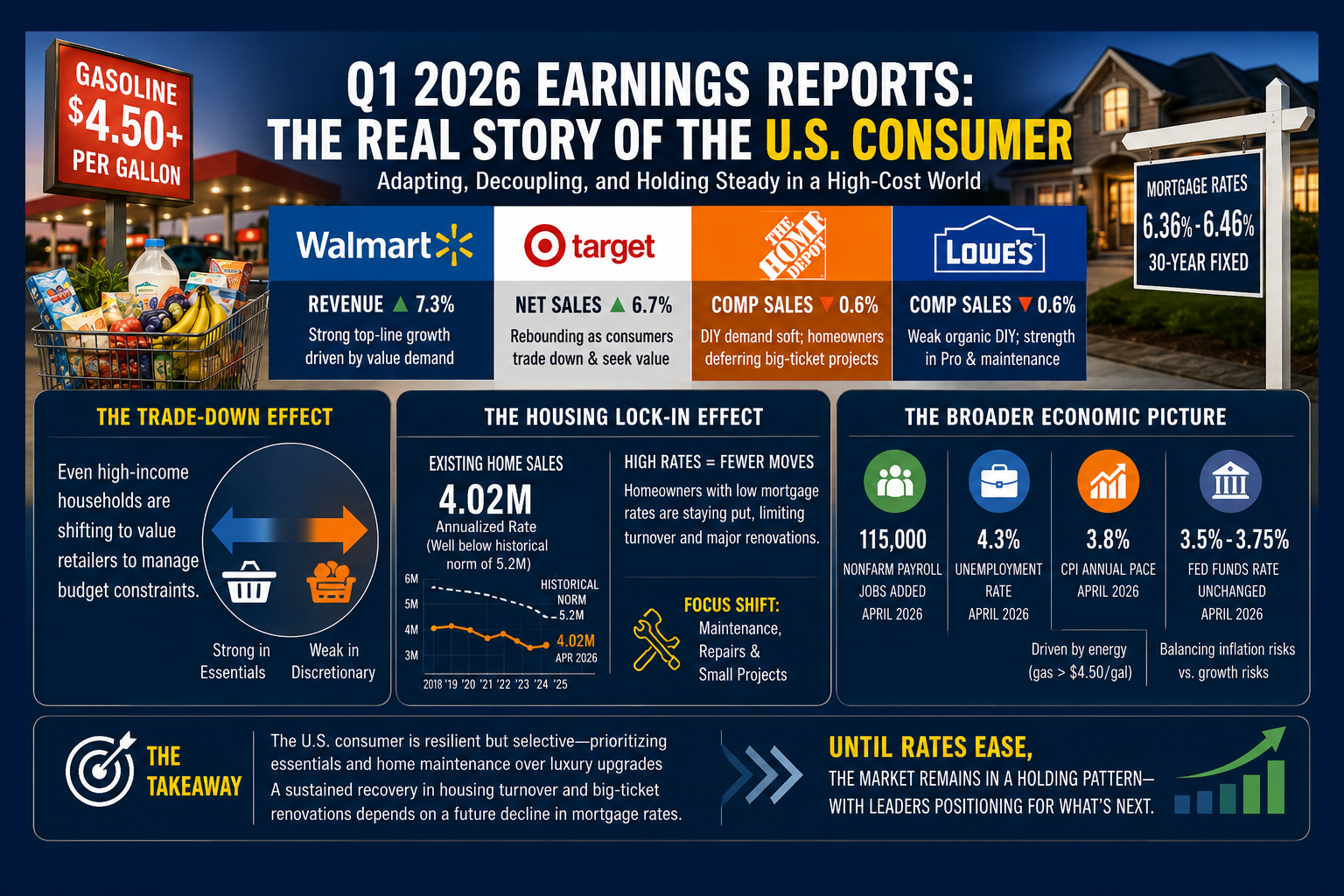
The Q1 2026 earnings reports from retail giants Walmart, Target, Home Depot, and Lowe's offer a highly detailed, real-time diagnostic of the United States consumer and the broader macroeconomic landscape. Operating under the compounding pressures of sticky inflation, elevated borrowing costs, and geopolitical shocks, the American household is undergoing a pronounced structural shift. In April 2026, the Consumer Price Index (CPI) rose at a 3.8% annual pace, driven heavily by energy shocks that pushed retail gasoline above $4.50 per gallon. Concurrently, the average 30-year fixed mortgage rate has hovered between 6.36% and 6.46%, creating significant friction for prospective homebuyers and directly impacting how Americans allocate their spending.
Instead of a uniform economic contraction, these earnings prints reveal a clear "decoupling" of consumer behavior. General merchandise retailers experienced surprisingly robust top-line growth, with Walmart reporting a 7.3% revenue increase and Target rebounding with a 6.7% jump in net sales. However, this growth is largely underpinned by a "trade-down" effect, where even high-income households are shifting their spending to value-tier retailers to manage budget constraints. Consumers are actively consolidating their spending around daily essentials, value-oriented groceries, and digital convenience while pulling back on long-duration, large-ticket discretionary commitments.
For the housing market, the financial results from Home Depot and Lowe's highlight the profound impact of the current "housing lock-in" effect. With mortgage rates remaining elevated, homeowners who secured low rates in previous years are strongly discouraged from selling, keeping existing home sales flat at an annualized rate of roughly 4.02 million units—far below the historical norm of 5.2 million. This lack of housing turnover has directly depressed organic demand for discretionary home improvement projects. Both Home Depot and Lowe's reported sluggish comparable sales growth of just 0.6% for the quarter, as homeowners defer major, big-ticket remodeling projects like kitchen renovations and additions.
Despite the pause on major renovations, the housing and home improvement markets have established a stabilizing structural floor. Homeowners are not abandoning their properties; rather, they are pivoting toward necessary routine maintenance, repairs, and smaller-scale outdoor projects. A major bright spot in this environment is the professional (Pro) contractor segment, which remains highly active on smaller commercial and residential repair jobs. To adapt to weak organic DIY demand, both Home Depot and Lowe's are leaning heavily into digital AI tools and multibillion-dollar acquisitions such as Home Depot's purchase of SRS Distribution and Lowe's acquisition of Foundation Building Materials to aggressively capture market share in the fragmented Pro and commercial sectors.
Looking at the broader U.S. economy, the data suggests that the American consumer is adapting rather than breaking. Aggregate spending continues to be supported by a remarkably stable labor market, which added 115,000 nonfarm payroll jobs in April while maintaining a low unemployment rate of 4.3%. However, persistent upstream wholesale pressures and sticky inflation complicate the path forward for the Federal Reserve. In April 2026, the Fed kept its benchmark interest rate unchanged at a restrictive 3.5%–3.75%, balancing the need to curb stubborn price pressures against the risk of triggering a deeper contraction in interest-rate-sensitive sectors.
For real estate professionals and investors, the takeaway is a market defined by resilience but constrained by affordability. The consumer remains financially active but highly selective, prioritizing essentials and home maintenance over luxury upgrades and moving. A sustained recovery in housing turnover and big-ticket discretionary renovations remains heavily contingent on a future decline in mortgage rates. Until borrowing costs ease, the market will likely remain in this holding pattern, with industry leaders positioning themselves to capitalize on the eventual acceleration of housing activity.
Chris Cusimano
.png)
Sources:
- America In Focus: Hotter inflation doesn't stop consumers, investors | The Associated Press:https://www.ap.org/news-highlights/elections/2026/america-in-focus-hotter-inflation-doesnt-stop-consumers-investors/
- Earnings Release (FY27 Q1) - Walmart:https://stock.walmart.com/_assets/_073745ae8c54e2cd48e8e649fea81965/walmart/db/938/9995/earnings_release/Earnings+Release+%28FY27+Q1%29.pdf
- Target Corporation Reports First Quarter Earnings: https://corporate.target.com/press/release/2026/05/target-corporation-reports-first-quarter-earnings
- The Home Depot Announces First Quarter Fiscal 2026 Results:https://corporate.homedepot.com/news/earnings/home-depot-announces-first-quarter-2026-earnings
- Lowe's Reports First Quarter 2026 Sales and Earnings Results: https://corporate.lowes.com/newsroom/press-releases/lowes-reports-first-quarter-2026-sales-and-earnings-results-05-20-26
- United States Fed Funds Interest Rate - Trading Economics: https://tradingeconomics.com/united-states/interest-rate

Chris Cusimano
| Homes by Cusi | Keller Williams Realty Boca Raton | PLACE | Boca Raton Realtors
or another way