
Categories
2026, Coral Springs, Current EventsPublished October 9, 2026
Found Injured Wildlife in Broward or Palm Beach? A Homeowner's Call-First Guide

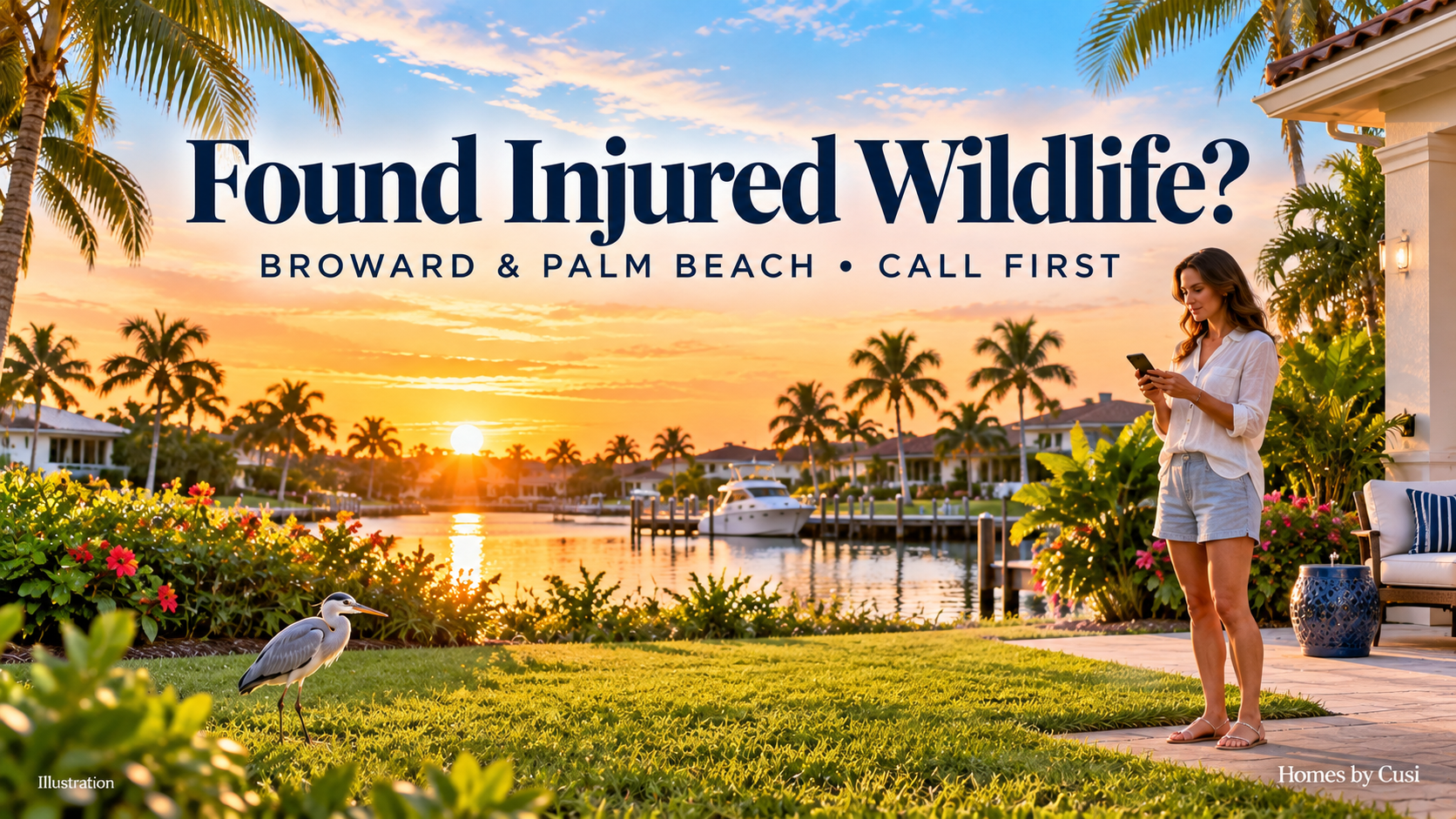
Contact information and intake guidance checked October 8, 2026. This guide is not veterinary advice. Call a licensed wildlife professional before handling or transporting an animal.
A bird is sitting on your driveway. A squirrel is under the hedge. An animal near the canal looks hurt. Your first instinct may be to pick it up and help. In Broward and Palm Beach County, the better first move is often to step back and make a call.
Living here means sharing yards, lakes, trees and waterfronts with wildlife. Knowing who to contact is a useful part of being a South Florida homeowner. It does not require becoming an animal rescuer, and it should never put you, your family or the animal at risk.
This guide builds on The Friendly Scoop's local wildlife rescue guide, with contact details checked against the rescue centers and the Florida Fish and Wildlife Conservation Commission, or FWC.
Start with distance, not a rescue attempt
Keep children and pets away. Note the exact location and watch from a safe distance. If you can observe without approaching, describe what you see to a wildlife professional: the type of animal, whether it is bleeding, whether it can move normally, and whether a cat or dog had contact with it.
Do not feed it, offer water, give medicine or try to treat an injury. Do not pull out a fishing hook or line. Call before attempting capture or transport. The right response depends on the species, its condition and the situation. A distressed wild animal can bite or scratch, and a well-meant intervention can make an injury worse.
If a person is bitten or scratched, get medical advice promptly. An immediate threat to human safety is an emergency, not a wildlife-care project. Call 911 when emergency help is needed.
A young animal alone is not automatically orphaned
FWC says that most baby animals people find are not actually orphaned. A parent may be looking for food or watching from a distance. Picking up a healthy young animal can separate it from the care it already has.
A fully feathered young bird on the ground may be a fledgling learning to fly, with parents still feeding it. Rather than moving it or taking it home, keep pets back and call a licensed rehabilitator if you are unsure. Busch Wildlife Sanctuary's rescue page includes decision charts for baby birds, rabbits and squirrels. Those are useful references, but they are not a reason to handle an animal you cannot safely identify.
Visible bleeding, impaired movement or contact with a cat or dog warrants prompt professional advice. Tell the rehabilitator what happened even if you do not see an obvious wound. Let the professional decide whether the animal needs intake, observation or another response.
Who to call in Broward County
South Florida Wildlife Center, Fort Lauderdale
Phone: (954) 524-4302. Address: 3200 SW 4th Avenue, Fort Lauderdale, FL 33315.
The center treats native and migratory wildlife, but its services have species-specific limits. Call to describe the animal and confirm that it can be accepted before you travel. Its official homepage and FAQ currently show different closing times, so this guide does not promise a specific intake window. Confirm admissions hours directly.
That call also matters if you cannot transport an animal. Do not assume a pickup is available or arrange transport before discussing the situation with the center.
Sawgrass Nature Center & Wildlife Hospital, Coral Springs
Phone: (954) 752-9453. Address: 3000 Sportsplex Drive, Coral Springs, FL 33065.
The wildlife hospital's posted intake hours are Tuesday through Friday, 9:30 a.m. to 4 p.m., and Saturday and Sunday, 10 a.m. to 2 p.m. It is closed Monday. Call during business hours before heading over.
The nature center and hospital do not have the same hours. The nature center stays open later, but animal intake stops when the hospital closes. Sawgrass says it does not monitor voicemail outside business hours and does not accept animals after the hospital closes. Leaving a message late at night is not the same as reaching a responder.
Who to call in Palm Beach County
Busch Wildlife Sanctuary, Jupiter
Main phone: (561) 575-3399. Address: 17855 Rocky Pines Road, Jupiter, FL 33478.
Busch's rehabilitation center lists injured-animal intake seven days a week from 8 a.m. to 4:30 p.m. These are rescue intake hours, not the sanctuary's public visitor schedule. Call to confirm the animal's needs and the intake plan.
After-hours hotline: (561) 599-0071. Busch says an after-hours drop-off can sometimes be arranged when a volunteer is available. That is conditional assistance, not a promise of an open hospital or immediate pickup. Call, explain the situation and follow the response you receive.
Sea turtles and certain other species need FWC
Call FWC's Wildlife Alert Hotline at (888) 404-3922 for injured, sick, orphaned or dead sea turtles, manatees, dolphins, whales, Florida panthers or black bears. FWC directs reports involving these species to its trained responders.
Do not move or handle these animals. Give the location as precisely as possible, including a beach access point or nearby landmark when relevant. FWC's sea turtle reporting page identifies the number as a 24-hour hotline.
For other wildlife, use FWC's licensed rehabilitator information when your first local call cannot help. Rehabilitators may be busy caring for animals, and response times vary. Outside normal business hours, FWC's injured-wildlife page also directs people who need more guidance to the Wildlife Alert Hotline. A call is a request for help, not a guarantee that a responder will arrive immediately.
Ask about species before you drive
A wildlife hospital is not a general animal shelter. Native wildlife, domestic pets and nonnative animals can need different organizations. Sawgrass and South Florida Wildlife Center both state that they do not admit injured Muscovy ducks. If you find one, call for a referral rather than arriving assuming it will be accepted.
The same call-first rule applies when you cannot identify the animal. Describe it from a distance and ask what information the center needs. Do not approach just to get a closer photograph. Do not assume a facility that treats birds can accept every bird species or every condition.
What to say on the call
Have your callback number and the location ready. Explain when you noticed the animal, what it is doing, whether it has visible injuries, and whether a pet was involved. Say if it is near traffic or another immediate hazard, without putting yourself in that hazard.
Ask whether the center accepts that species, whether intake is open, and what it wants you to do next. If transportation is recommended, ask for safe instructions first. If you cannot safely follow them, say so. Do not improvise a capture, release or relocation plan.
A few habits that help around the house
Secure trash and bring pet food indoors rather than leaving a regular food source outside. Supervise pets outdoors. If you see nesting activity near planned yard work, pause and ask for advice before disturbing the area. These simple habits can reduce avoidable conflicts without trying to remove all wildlife from your neighborhood.
Wildlife presence is a normal part of South Florida life. It is not a shortcut for judging a neighborhood's safety or predicting a home's value. If you are buying, consider the property's actual setting, maintenance needs and your own practical priorities.
Save the contacts before you need them
Broward: South Florida Wildlife Center, (954) 524-4302. Northwest Broward: Sawgrass, (954) 752-9453. Palm Beach County: Busch, (561) 575-3399; after-hours hotline, (561) 599-0071. FWC Wildlife Alert: (888) 404-3922.
Keep this guide handy, but check the provider's current instructions whenever an incident happens. Hours, capacity and accepted species can change. For a closer look at the places and practical details that shape life in Broward and Palm Beach County, Homes by Cusi can help you explore the area with clear information, not guesses.
Sources and further reading
- The Friendly Scoop: local wildlife rescue guide
- FWC: injured and orphaned wildlife
- FWC: reporting sick, injured or dead sea turtles
- South Florida Wildlife Center and wildlife FAQ
- Sawgrass Nature Center & Wildlife Hospital
- Sawgrass: found an injured animal
- Busch Wildlife Sanctuary: rescue and rehabilitation
Chris Cusimano
| Homes by Cusi | Keller Williams Realty Boca Raton | PLACE | Boca Raton Realtors
or another way